

Memoblast Explained: What You Should Know Before Using It
You may have seen Memoblast promoted as a way to support memory, focus, concentration, and mental clarity, especially if you have been dealing with occasional forgetfulness or mental fatigue. But there is a catch: online pages using the Memoblast name do not always describe exactly the same formula. That makes it worth looking beyond the sales claims. This guide explains what Memoblast is marketed for, what its ingredients are claimed to do, potential benefits, common concerns, and how to evaluate the product sensibly.
Quick Summary
- Memoblast is marketed online as a dietary supplement for memory, focus, and general cognitive support.
- Product pages do not consistently publish the same ingredient list or formulation.
- Some versions mention ingredients such as Ginkgo biloba, Bacopa monnieri, N-acetyl L-carnitine, Huperzia serrata, or phosphatidylserine, while another product page highlights coffee extract, polyphenols, quercetin, and EGCG.
- Evidence for individual cognitive-support ingredients varies, and evidence for the specific Memoblast formulation is limited.
- “Natural” does not automatically mean risk-free, and dietary supplements are not FDA-approved for safety and effectiveness before marketing in the United States.
- Anyone taking prescription medicines or managing a medical condition should discuss a supplement with a healthcare professional before use.
What Is Memoblast?
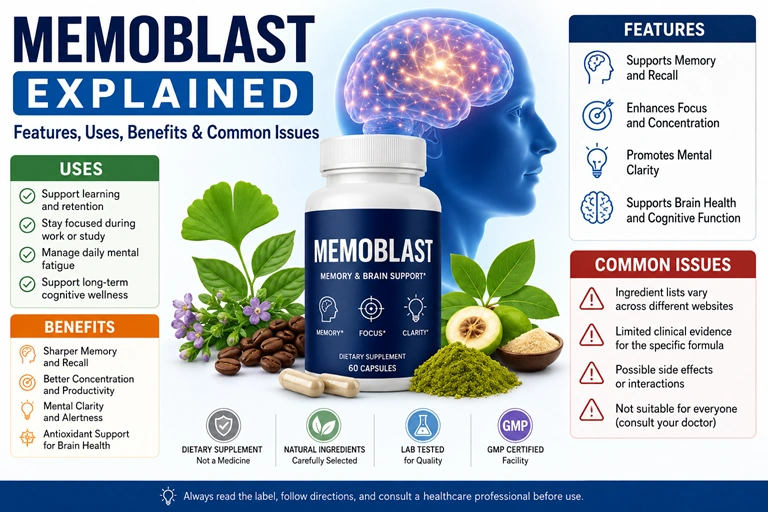
Memoblast, also written as MemoBlast or Memo Blast, is marketed as a brain-health or cognitive-support dietary supplement. Promotional pages generally position it around four familiar goals: better memory, sharper focus, improved concentration, and greater mental clarity. Some versions also make broader claims involving learning, reasoning, mental energy, stress resilience, or protection against cognitive decline.
The first thing a careful buyer should understand is that “Memoblast” does not appear to have one consistently documented formula across the web. Different commercial pages list different ingredients and even different serving directions. One sales page describes a four-ingredient blend involving concentrated coffee extract, a polyphenol complex, quercetin, and EGCG, while other pages describe broader nootropic-style combinations.
That inconsistency matters. A supplement’s effects and safety depend heavily on its actual ingredients, amounts, formulation, and manufacturing quality—not simply the brand name printed on the bottle.
Is Memoblast a medicine?
No. Memoblast is marketed as a dietary supplement rather than a prescription medicine.
That distinction is important when interpreting advertising. In the United States, the FDA does not approve dietary supplements for safety and effectiveness before they reach consumers. Companies are responsible for ensuring that their products comply with applicable safety, manufacturing, and labeling requirements.
So claims that a supplement is “FDA approved” should be treated carefully. The FDA itself says it does not approve dietary supplements in the same way it approves prescription medicines.
What Are the Main Features and Uses of Memoblast?
The exact features depend on the version being sold, but the marketing around Memoblast consistently focuses on cognitive support.
Memory and recall support
Memory is the headline benefit behind the product. Marketing materials claim that Memoblast can help users remember information, improve recall, and maintain sharper mental performance. Some pages specifically connect these claims with ingredients such as Bacopa monnieri and Ginkgo biloba.
That does not mean the finished product has been proven to improve memory. Research on individual ingredients cannot automatically be transferred to a commercial combination. Dose, extract standardization, formulation, and study design all matter.
Focus and concentration
Memoblast is also marketed toward people who struggle to stay focused during work, study, reading, or other mentally demanding activities. Some product descriptions mention mental clarity and sustained concentration as key goals.
This is a reasonable use case to investigate, but expectations should remain realistic. Feeling more alert after taking a product does not necessarily mean that long-term memory or cognitive ability has improved.
Mental energy
Several Memoblast descriptions frame the formula as a way to support mental energy without relying heavily on conventional stimulants. Other versions, however, specifically mention concentrated coffee extract, meaning the actual stimulant profile may depend on the product being purchased.
This is one reason checking the physical bottle’s Supplement Facts panel is more useful than relying on a generic webpage.
General brain-health support
Some promotional pages go beyond everyday focus and describe Memoblast as supporting brain circulation, neurotransmitter activity, antioxidant defenses, and long-term cognitive wellness.
These are broader biological claims. They should not be interpreted as evidence that Memoblast can prevent Alzheimer’s disease, reverse dementia, or treat a neurological condition. Current evidence does not support assuming that dietary supplements can prevent dementia or Alzheimer’s disease.
What Ingredients Are in Memoblast?
This is where prospective buyers should slow down.
Online sources currently associated with Memoblast describe different ingredient combinations, so it would be misleading to present one ingredient list as universally definitive. Reported ingredients include Ginkgo biloba, Bacopa monnieri, N-acetyl L-carnitine, Huperzia serrata/Huperzine-related compounds, phosphatidylserine, and other nootropic ingredients on some pages. Another sales presentation identifies concentrated coffee extract, polyphenols, quercetin, and EGCG.
Ginkgo biloba
Ginkgo is one of the better-known herbs marketed for cognitive support. However, the evidence is mixed. The National Center for Complementary and Integrative Health says there is no conclusive evidence that ginkgo prevents or slows dementia or cognitive decline.
That is a useful reality check when evaluating strong advertising claims.
Bacopa monnieri
Bacopa is another botanical commonly associated with memory and learning supplements. Some research has investigated its effects on cognition, but evidence for an individual ingredient should not be confused with clinical evidence for the entire Memoblast product.
Coffee extract, polyphenols, quercetin and EGCG
One Memoblast sales presentation lists these four ingredients as its central formula. Coffee-derived compounds may influence alertness, while polyphenols, quercetin, and EGCG are commonly discussed for their antioxidant properties.
Again, the presence of an ingredient with scientific literature behind it does not prove that the particular dose or combination in Memoblast produces the same effect.
What Are the Potential Benefits of Memoblast?
The potential benefits are best separated into what the product is marketed to do and what has actually been demonstrated.
According to promotional material, the main intended benefits include:
- Supporting memory and recall
- Improving concentration
- Supporting mental clarity
- Helping with occasional mental fatigue
- Supporting learning and cognitive performance
- Providing general brain-health support
- Supporting antioxidant defenses
Some consumers may notice a subjective improvement in focus or alertness, particularly if a formulation contains stimulating ingredients. But subjective improvement is not the same thing as a clinically demonstrated improvement in memory.
NCCIH notes that many dietary supplements are promoted for memory and brain health, while direct evidence that such products prevent Alzheimer’s disease or other forms of dementia remains lacking.
For that reason, Memoblast is better viewed as a supplement marketed for general cognitive support, rather than a treatment for memory disorders.
Common Memoblast Issues and Concerns
1. Inconsistent ingredient information
Perhaps the biggest practical issue is the variation among online product pages. Different websites identify different ingredients, serving sizes, and formulations.
Before buying, compare the claims on the website with the actual bottle label. If the label does not clearly identify ingredients and quantities, that is a reason to pause.
2. Marketing claims may exceed the evidence
Statements suggesting that a supplement can “restore” memory, reverse cognitive decline, or produce dramatic results deserve skepticism unless supported by high-quality clinical trials of the actual product.
Research on Ginkgo, for example, has not established a reliable ability to prevent or slow dementia.
3. “Natural” does not mean automatically safe
Herbal ingredients can interact with medications and can cause unwanted effects. FDA specifically advises consumers to discuss dietary supplements with a doctor, pharmacist, or other healthcare professional because supplements can interact with medicines or other supplements.
4. Lack of product-specific clinical evidence
A common mistake is to see a study about one ingredient and assume that the finished supplement has been clinically proven.
Those are two different things.
A strong product-specific evidence base would ideally include a clearly defined formula, standardized doses, an appropriate placebo-controlled clinical trial, and independently reported results. Available Memoblast material does not establish that level of evidence for the specific product.
5. Different versions can create confusion
If two websites sell “Memoblast” but list substantially different formulas, consumers should not assume they are interchangeable. Check the manufacturer, Supplement Facts panel, serving size, lot information, and contact details before purchasing.
How Should You Evaluate Memoblast Before Buying?
A five-minute label check can tell you more than a long promotional video.
Look for:
- Complete ingredient list: Every dietary ingredient should be identified.
- Amount per serving: “Proprietary blend” language can make comparisons difficult.
- Serving instructions: Do not assume that directions from one website apply to another version.
- Manufacturer information: Look for a clear company name and contact details.
- Lot or batch information: Useful for traceability.
- Return policy: Read the actual terms rather than relying on a large “money-back guarantee” badge.
- Health claims: Be cautious about claims that sound like treatment or disease reversal.
- Independent evidence: Look for research on the finished formulation, not only individual ingredients.
FDA says dietary supplement labels are expected to include a Supplement Facts panel with serving size, servings per container, dietary ingredients, and amounts per serving.
Is Memoblast Worth Considering?
That depends on what you expect from it.
If your goal is simply to explore a general cognitive-support supplement, the product may appear attractive because of its focus on memory and concentration. But if you are looking for a scientifically established treatment for persistent memory problems, Memoblast should not be treated as a substitute for medical evaluation.
Persistent or worsening forgetfulness can have many causes, including sleep problems, medication effects, nutritional issues, stress, depression, or neurological conditions. A supplement cannot determine the underlying cause.
The bigger lesson is simple: evaluate the actual formula, evidence, and safety information rather than the marketing headline.
Frequently Asked Questions About Memoblast
What is Memoblast used for?
Memoblast is marketed as a dietary supplement for memory, focus, concentration, mental clarity, and general cognitive support. It is not established as a treatment for dementia, Alzheimer’s disease, or other neurological disorders.
Does Memoblast really improve memory?
There is insufficient product-specific clinical evidence to say that Memoblast reliably improves memory. Some individual ingredients marketed in cognitive supplements have been studied, but results for those ingredients cannot automatically prove the effectiveness of the finished product.
Is Memoblast FDA approved?
Dietary supplements are not FDA-approved for safety and effectiveness before marketing in the United States. Therefore, an online claim that a dietary supplement is “FDA approved” should not be interpreted as equivalent to FDA approval of a prescription medicine.
Can Memoblast cause side effects or interact with medicines?
Potential risks depend on the exact ingredients and doses in the product. Some botanical and stimulant ingredients can cause unwanted effects or interact with medicines. Check the current label and speak with a healthcare professional before using it, especially if you take prescription medication.
Final Takeaway
Memoblast is marketed as a memory and cognitive-support supplement, but the online information surrounding the product is not fully consistent. Different pages describe different formulations, while strong claims about cognitive improvement are not the same as product-specific clinical evidence.
If you are considering Memoblast, start with the bottle’s actual Supplement Facts panel, verify the manufacturer, review the ingredients and doses, and avoid treating promotional claims as medical proof. For persistent memory changes, professional medical advice is far more valuable than simply adding another supplement to your routine.