


If a strange message suddenly tells you that you have a fix Zenvekeypo4 software issue, your first instinct may be to search for a repair tool or download the program. That is exactly where caution matters. Public information about Zenvekeypo4 is inconsistent, and there is no strong, independently verified documentation establishing it as a mainstream software product. Several pages discussing the term instead describe suspicious pop-ups, redirects, or unverified software claims.
The safest approach is therefore not to assume that Zenvekeypo4 is a normal application that simply needs reinstalling. First determine where the warning came from, then remove the source and check your device for unwanted software.
Quick Summary
- Do not download a “Zenvekeypo4 fix” from an unfamiliar website.
- If the warning appeared only inside your browser, treat it as a potentially deceptive pop-up rather than proof of a system infection.
- Never call a phone number displayed in a suspicious software or security warning.
- Remove unfamiliar browser notifications, extensions, and recently installed applications.
- Run a full security scan after closing the warning.
- If you installed software or granted remote access because of the alert, take additional security steps immediately.
- Use official software sources and trusted vendor support when reinstalling legitimate applications.
Is Zenvekeypo4 a Real Software Program?
This is the first question worth answering before attempting any repair.
There is currently limited reliable public documentation identifying Zenvekeypo4 as an established software product. Some websites describe it as general-purpose software, while others make much stronger claims about its functionality without providing verifiable developer documentation.
That uncertainty changes the troubleshooting strategy.
If you knowingly installed a program called Zenvekeypo4 from an organization you trust, you should start with the application’s own documentation, version information, and support channel. But if you first encountered the name through a random browser pop-up, an advertisement, a search result, or a warning saying your computer needs an urgent “Zenvekeypo4 fix,” do not assume that the warning represents a genuine software failure.
Microsoft and the Federal Trade Commission both warn that fake technical-support alerts can imitate legitimate security messages and pressure users into calling numbers, downloading software, paying for unnecessary services, or granting remote access.
That makes the origin of the message more important than the error message itself.
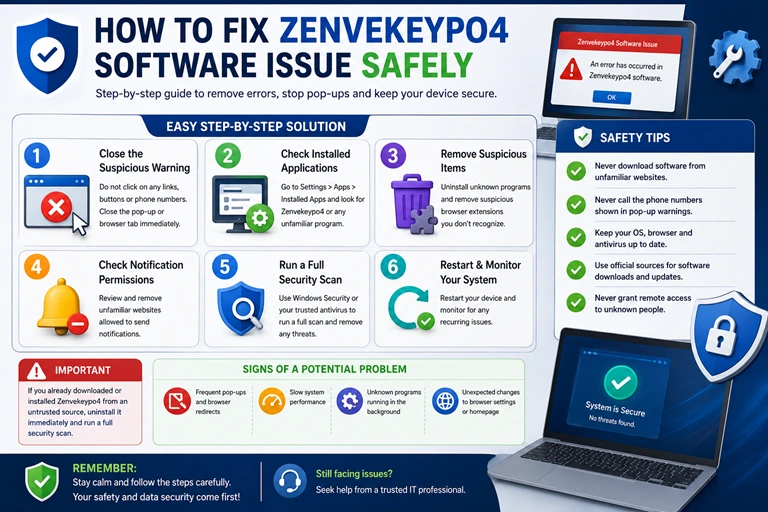
How to Fix Zenvekeypo4 Software Issue Safely
1. Close the suspicious warning without clicking it
Suppose you are browsing the web and suddenly see a message claiming that Zenvekeypo4 has stopped working, your computer is infected, or an urgent repair is required.
Don’t click Scan, Repair, Update, Download, or any phone number displayed in the warning.
Instead, close the browser tab or browser window. If the browser appears frozen, use your operating system’s normal method for closing an unresponsive application. Microsoft specifically recommends closing suspicious browser windows rather than interacting with fake error messages.
The distinction is simple:
A browser page can display an error message without that message being generated by your operating system.
That is one of the most common traps in technical-support scams.
2. Check whether Zenvekeypo4 is actually installed
Before uninstalling anything, check your installed applications.
On Windows, open Settings > Apps > Installed apps and search for Zenvekeypo4 or any unfamiliar application that appeared around the same time as the warning.
Don’t remove a legitimate program simply because its name looks unfamiliar. Check:
- Publisher or developer name
- Installation date
- Application description
- Whether you remember installing it
- Whether another trusted application depends on it
If you cannot identify the application and it appeared immediately before the suspicious warnings began, investigate it before running or reinstalling it.
If Zenvekeypo4 does not appear in your installed applications, that is another reason to question whether the “software issue” is actually a software issue at all.
3. Remove suspicious browser extensions
A browser extension can change your browsing experience, redirect searches, display advertisements, or interfere with normal pages.
Open your browser’s extension or add-on manager and review everything installed.
Look particularly closely at extensions that:
- You don’t remember installing
- Have generic or unusual names
- Were installed recently
- Request permissions unrelated to their advertised purpose
- Redirect searches or open unexpected pages
Remove extensions you do not trust. If the problem disappears afterward, the extension may have been responsible for the unwanted behavior.
4. Check browser notification permissions
This step is easy to overlook.
Some websites persuade visitors to click Allow when they supposedly need permission to show content, verify that the user is human, or continue browsing. That permission can later be abused to send alarming notifications to the desktop.
In Microsoft Edge, for example, site notification permissions can be reviewed through the browser’s settings. Microsoft guidance also recommends removing or blocking unfamiliar websites from notification permissions when dealing with fake security alerts.
The same principle applies to Chrome and other browsers: inspect the websites allowed to send notifications and remove entries you don’t recognize.
This can stop a recurring “Zenvekeypo4 software issue” notification without reinstalling your operating system.
5. Run a full security scan
Once the suspicious page or application has been removed, scan the device.
On Windows, use Windows Security and run a Full scan rather than relying only on the absence of another pop-up.
Why bother if the warning may have been fake?
Because the warning itself does not prove whether your computer is clean. A malicious website may simply have frightened you, but an unwanted application or browser component could also have been installed.
Microsoft recommends running a full security scan when users have interacted with tech-support scams or suspicious software.
Keep your operating system and security software updated as well. Security updates are not a cure for every browser problem, but they reduce exposure to known vulnerabilities.
What If Zenvekeypo4 Keeps Appearing?
If the message returns after you restart the browser, work through the problem systematically instead of repeatedly clicking the warning.
Check startup applications
Look at the applications configured to start automatically with your operating system. An unfamiliar program that launches every time the computer starts deserves investigation.
Review recently installed software
Think back to what happened immediately before the alerts began.
Did you install:
- A free utility?
- A browser extension?
- A media converter?
- A “driver updater”?
- A download manager?
- A program from an unofficial website?
If the timing matches, that installation deserves closer inspection.
Reset the browser if necessary
If unwanted redirects, notifications, or pop-ups continue despite removing individual extensions, a browser reset may be appropriate. Before doing so, make sure important passwords, bookmarks, and other browser data are available through your normal account or backup method.
Check another browser
This is a useful diagnostic trick.
If the warning appears in one browser but not another, the problem may be browser-specific rather than a system-wide software failure. That doesn’t prove the browser itself is infected, but it gives you a valuable clue.
What Should You Do If You Already Downloaded a Zenvekeypo4 “Fix”?
This situation deserves more caution.
If you downloaded an executable or installer because a pop-up told you to fix the Zenvekeypo4 problem, do not run it if you have not already done so.
Delete it or have your security software inspect it first.
If you already installed it, uninstall the application if you can identify it safely, then run a full security scan. Microsoft recommends removing applications that were installed at the direction of a technical-support scam and considering stronger recovery measures when the device continues showing fake alerts.
The situation is more serious if you gave someone remote access to your computer.
Remote-access software can allow another person to see or control the machine. Microsoft and the FTC both warn that tech-support scammers may use remote access to steal information or install unwanted software.
In that case:
- Disconnect the device from the internet if you believe an unauthorized person still has access.
- Remove remote-access software you were instructed to install.
- Run a full security scan.
- Change important passwords from a clean, trusted device.
- Monitor financial accounts if payment information was exposed.
- Contact the relevant service provider or financial institution if money or account credentials were compromised.
How to Prevent Another Zenvekeypo4 Software Issue
Prevention starts with changing one habit: don’t treat a pop-up as your support desk.
If software genuinely needs an update, open the application’s settings yourself or visit the developer’s official website by entering the address manually. Don’t trust a download button presented by an unexpected warning.
Microsoft recommends downloading software from official vendor websites or trusted stores and warns that third-party downloads can sometimes be modified or bundled with unwanted software.
A few simple habits make a substantial difference:
- Keep Windows, macOS, browsers, and security tools updated.
- Install applications from reputable sources.
- Review browser extensions periodically.
- Don’t allow unfamiliar websites to send notifications.
- Don’t provide remote access to unsolicited “support agents.”
- Never give passwords, banking details, or verification codes to someone responding to a pop-up.
- Keep important files backed up.
If an alert creates extreme urgency — “call now,” “your computer will be locked,” or “pay immediately” — slow down. Urgency is often part of the manipulation.
When Should You Get Professional Help?
You don’t necessarily need a technician because a strange browser warning appeared once.
Professional help becomes more appropriate when:
- Suspicious programs keep reinstalling themselves.
- Security software repeatedly detects threats.
- Your accounts show unauthorized activity.
- Someone had remote access to your computer.
- The operating system becomes unstable.
- Important files have been encrypted or altered.
- You cannot determine whether a business-critical computer is compromised.
For a work computer, don’t immediately start deleting system files or changing security policies. Contact your organization’s IT administrator so they can preserve logs and investigate the incident properly.
The goal is not simply to make the warning disappear. It is to determine why it appeared and whether anything unwanted was installed.
Frequently Asked Questions
Is Zenvekeypo4 software legitimate?
There is limited publicly verifiable information establishing Zenvekeypo4 as a recognized software product. If you encountered the name through an unsolicited pop-up or download prompt, treat it cautiously rather than assuming it is legitimate.
How do I fix a Zenvekeypo4 software issue?
First close any suspicious pop-up, then check installed applications, browser extensions, and notification permissions. Remove unfamiliar software and run a full security scan. Avoid downloading unofficial “fix” tools.
Should I download Zenvekeypo4 to fix the error?
No, not simply because a pop-up tells you to. Verify the software and its developer independently first. Unsolicited download prompts can be part of technical-support scams or malware distribution.
What if the Zenvekeypo4 warning keeps coming back?
Check browser notification permissions, extensions, recently installed applications, and startup programs. If the alerts continue after those checks, run a full security scan and consider professional technical assistance.
Conclusion
The safest way to fix Zenvekeypo4 software issue is to avoid assuming that the mysterious name represents a genuine software malfunction. Public documentation is too limited to justify blindly reinstalling or downloading a program under that name.
Start with the source of the warning. If it appeared in a browser, remove the browser-based cause. If an actual application is installed, verify its publisher and investigate its behavior. And if you downloaded something or granted remote access because of the warning, treat the situation as a potential security incident rather than an ordinary software error.
A strange error deserves investigation — not panic. That’s the principle that can save you from turning a questionable pop-up into a genuine computer problem.