


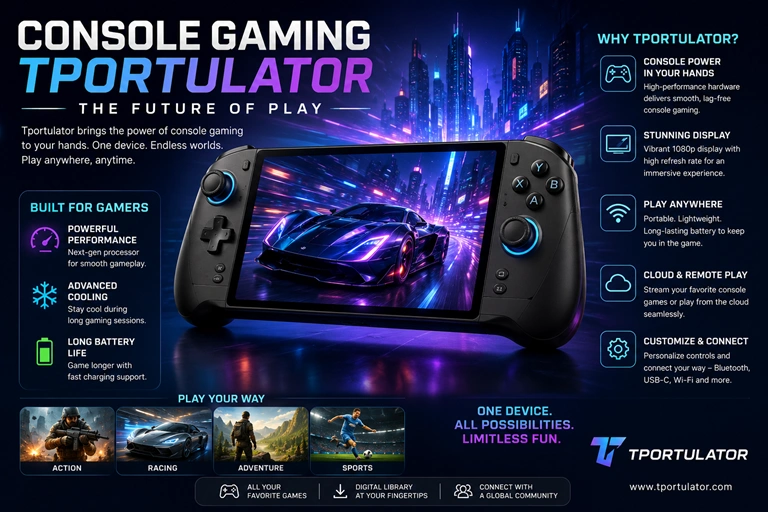
Imagine putting down your controller and realizing you never needed the screen in the first place. Instead of watching a character run through a digital world, you experience that world directly. That is the idea behind the console gaming tportulator—a futuristic concept built around taking console gaming beyond displays, controllers, and traditional virtual reality.
The term is currently associated with Tportulator, a gaming-focused site that describes the concept in terms of deep immersion and experimental future technology. It should be treated as a concept rather than an established consumer console.
Quick Summary
- The console gaming tportulator is best understood as a futuristic gaming concept, not a commercially established console.
- Its central idea is moving beyond screens toward highly immersive or direct neural gaming.
- Brain-computer interfaces provide a real-world technological reference point, but they do not currently offer full sensory transfer into a game.
- Quantum mechanics and quantum computing are sometimes discussed alongside the concept, but they should not be confused with working gaming teleportation technology.
- The biggest barriers are neuroscience, safety, latency, computing requirements, and the practical limits of human biology.
What Is a Console Gaming Tportulator?
At its simplest, a console gaming tportulator imagines a gaming system that dramatically reduces the distance between the player and the virtual environment.
Traditional console gaming follows a familiar chain: your input goes through a controller, the console processes it, and the display and speakers return information to your senses. Even advanced haptic controllers still leave you physically outside the game.
The Tportulator concept takes that idea much further. One description envisions a system capable of reading a player’s intentions while delivering sensory information directly to the brain. In that hypothetical model, you would not merely see a character move—you could potentially experience the virtual environment from within it.
That distinction matters. This is closer to speculative neural gaming or full-dive immersion than to a conventional next-generation console.
How Could Tportulator Technology Work?
Brain-computer interfaces are the closest real-world comparison
The most credible technological foundation is the brain-computer interface (BCI). BCIs are being researched for applications such as translating neural activity into computer commands.
But there is a huge difference between controlling a cursor with neural signals and feeding a complete artificial reality into the human brain.
A true Tportulator-style system would theoretically need two-way communication:
- Read: Detect the player’s intended movements, choices, and possibly emotional or sensory responses.
- Process: Translate those signals into game actions with extremely low latency.
- Write: Deliver convincing sensory information back to the nervous system.
- Synchronize: Keep the player’s perception aligned with the game world.
That last step may be the hardest. Sight and sound are only part of human perception. A convincing virtual environment would need to account for touch, balance, body position and potentially other senses.
Current gaming hardware is nowhere close to providing that complete loop.
What about quantum technology?
This is where online discussions can become misleading.
Quantum computing and quantum physics are genuine areas of scientific research, but they do not currently provide a way to teleport a person’s consciousness into a video game. References to quantum technology in discussions of the Tportulator should therefore be understood as speculative rather than evidence of an existing product.
That distinction keeps the idea interesting without turning science fiction into a product claim.
What Would Console Gaming Tportulator Change?
If technology ever reached this level, game design would have to change with it.
A sword-fighting game, for example, could theoretically become less about pressing a button and more about physical or neural interaction. A racing game could aim to reproduce the sensation of acceleration, road texture and vehicle movement. Adventure games could create environments where spatial awareness becomes part of the gameplay rather than something represented through a screen.
There is also an intriguing possibility beyond entertainment: training simulations.
Virtual environments are already used for education and professional training in various forms. A much more advanced neural interface could eventually make simulations feel substantially more natural. However, claims that players could acquire real-world physical skills simply by entering a virtual environment remain speculative and should not be treated as established capability.
The biggest opportunity may not be better graphics. It could be entirely new genres designed around direct interaction.
What Is Stopping This From Becoming Reality?
The hardware challenge is only half the problem.
1. Neuroscience
Scientists would need a much more detailed understanding of how the brain encodes complex sensory experiences. Reading intention is one problem; safely generating an artificial experience is another.
2. Safety
A consumer gaming device that directly interacts with the nervous system would require an extraordinarily high safety standard. Developers could not treat a neural interface like a new controller firmware update.
Questions about session duration, neurological side effects, emergency shutdowns and physical monitoring would become central to product design.
3. Latency
Gamers already notice tiny delays in competitive games. A deeply immersive system would need exceptionally reliable communication between the player’s nervous system, hardware and game engine.
4. Privacy
Neural interfaces could introduce a new kind of personal data: information about brain activity and intent. Who owns that data? Who can store it? Could advertisers access it? These questions would need serious answers before widespread adoption.
Is the Tportulator a Real Gaming Console Today?
No established mainstream console currently offers the kind of consciousness-transfer or full-sensory gaming described by the Tportulator concept.
The Tportulator website presents itself as a gaming information platform and discusses the idea as part of futuristic gaming technology. Its own console-tech material describes the technology in theoretical terms, including concepts involving neural interfaces and immersive digital environments.
So if you encounter a claim that a Tportulator console can literally transport your consciousness into a game today, approach it cautiously. The concept is fascinating; the consumer technology is not there yet.
Frequently Asked Questions
What is console gaming tportulator?
Console gaming tportulator refers to a futuristic concept for highly immersive console gaming, potentially involving neural interfaces that could allow players to interact with digital environments more directly than conventional controllers or VR systems.
Is Tportulator a real gaming console?
There is no established mainstream consumer console that provides the full Tportulator-style experience. Current descriptions are largely conceptual and speculative rather than evidence of commercially available consciousness-transfer technology.
Could a gaming tportulator replace VR?
Potentially, if the technology described by the concept ever became technically and medically viable. A true neural interface could theoretically bypass some limitations of displays, but current VR remains dramatically more practical and mature.
When will Tportulator gaming be available?
There is no reliable release date for a full Tportulator-style gaming system. Claims suggesting a specific launch date should be treated as unless supported by credible technical or manufacturer documentation.
Final Takeaway
The console gaming tportulator is most useful as a vision of where gaming could eventually go, not as a product you can buy today. Its appeal comes from asking a bigger question: what happens when immersion stops meaning “better graphics” and starts meaning direct interaction between technology and the human brain?
We are still far from that future. For now, controllers, displays, VR headsets and increasingly sophisticated haptics remain the practical frontier. But the Tportulator idea highlights something worth watching: the next major leap in gaming may not come from making the screen sharper. It may come from making the boundary between player and game much thinner.