


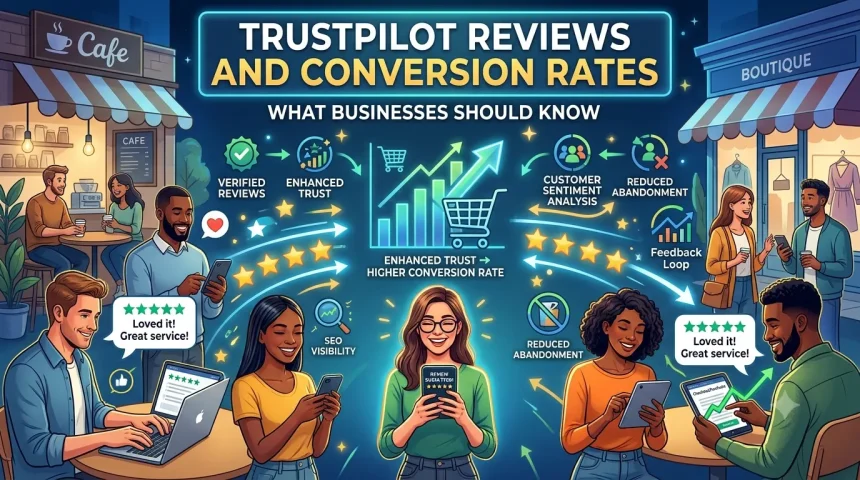
A visitor lands on your website, checks the product, compares the price, and gets close to clicking the purchase button. Then a doubt appears: Can I trust this company? That small moment of hesitation can be enough to send a potential customer back to Google to compare alternatives. Trustpilot reviews can help businesses address this uncertainty by giving shoppers access to customer feedback. But how much can reviews actually influence conversion rates, and what should businesses do to make that feedback useful?
How Do Trustpilot Reviews Influence Conversion Rates?
Conversion rate measures the percentage of visitors who complete a desired action, such as purchasing a product, booking a consultation, or submitting an enquiry.
For example, if an online store receives 2,000 visitors and 50 purchases, its purchase conversion rate is 2.5%. If 60 visitors purchase after a website improvement, the rate becomes 3%, assuming traffic remains at 2,000 visitors.
Trustpilot reviews may contribute to improvements like these by helping potential customers feel more confident about a business. They provide information beyond the claims made on a company’s own website.
Reviews can reduce uncertainty
Customers often hesitate when they are unfamiliar with a brand, particularly when buying expensive products, subscribing to a service, or sharing payment details with a new company.
Customer feedback can help answer practical questions:
- Does the business deliver what it promises?
- Is customer support responsive when something goes wrong?
- Are product descriptions accurate?
- Do customers report unexpected charges or confusing policies?
- How does the company handle complaints?
When reviews address these concerns, shoppers have more information to consider before purchasing.
However, reviews do not guarantee a conversion increase. Their impact depends on factors such as product quality, pricing, website usability, audience expectations, and the relevance of the feedback.
Reviews can support decisions at critical moments
A visitor browsing a blog may not be ready to buy. Someone viewing a pricing page or reaching checkout is often much closer to making a decision.
Customer feedback may be especially useful at these later stages, when doubts about reliability, service quality, or after-sales support can prevent a purchase.
Consider a business selling project management software. A prospective customer may already understand the features and pricing but remain uncertain about onboarding and support. Relevant reviews describing those experiences could help the customer decide whether the product fits their needs.
The key is to show useful information where it answers genuine questions, rather than adding review badges everywhere without considering the customer journey.
Why Does Customer Trust Matter for Online Sales?
Trust is not the only factor behind a purchase, but it can influence how customers evaluate risk. Two businesses may sell similar products at comparable prices, yet shoppers may feel more comfortable choosing the one that provides clearer policies, accessible support information, and credible customer feedback.
Social proof helps customers evaluate unfamiliar brands
Social proof refers to the tendency to consider other people’s experiences when making decisions. Reviews are one form of social proof because they let prospective customers learn from previous buyers.
For a small business competing with established brands, this information can help visitors understand what working with the company is actually like.
Imagine a customer comparing two web design agencies. Both have similar portfolios and pricing. One also has detailed feedback mentioning communication, project timelines, and how the team handled revisions. That information may help the customer assess the agency beyond its sales pitch.
Still, review quantity alone is not a reliable measure of quality. A large collection of vague comments may be less useful than a smaller set of detailed, relevant experiences.
Balanced feedback can be more informative than perfect-looking ratings
A profile containing only short, identical-sounding praise may give customers little practical information. Specific feedback about real experiences is often more useful because it explains what a business does well and where expectations may differ.
Negative reviews do not automatically destroy trust. What matters is the nature of the complaint, whether similar issues appear repeatedly, and how the business responds.
For example, a retailer that acknowledges a delivery delay and explains how it is addressing the issue gives future customers more context than one that ignores the complaint entirely.
Businesses should not attempt to manufacture a flawless reputation. The more sustainable goal is to deliver good service, invite honest feedback, and deal with problems responsibly.
How Can Businesses Use Trustpilot Reviews to Improve Conversions?
Collecting reviews is only the beginning. Businesses need to make the feedback relevant, accessible, and useful to people considering a purchase.
1. Place review information where it answers customer questions
Think about the questions a visitor might ask at different stages of the buying process.
On a product page, customers may want feedback about quality, delivery, or ease of use. On a service page, they may care more about communication, reliability, and the overall experience. Near checkout, clear information about returns, support, and company reputation may help address last-minute concerns.
Businesses can link to their Trustpilot profile or display permitted review information where it makes sense. Any rating, testimonial, or badge should be presented accurately and in line with the platform’s applicable display requirements.
Avoid cluttering the page with multiple competing trust badges. If everything is emphasised, nothing stands out.
2. Collect feedback from genuine customers
A useful review strategy starts with a straightforward invitation to customers who have had a genuine experience with the business.
The process should be consistent and neutral. Customers should be free to share positive, mixed, or negative feedback without pressure to leave a particular rating.
Businesses should avoid fabricated reviews, fake accounts, selective invitations designed to suppress criticism, or undisclosed incentives that breach platform rules. These practices can undermine credibility and create policy or legal risks.
ReviewMint can be a resource for businesses exploring review-related services and online reputation management. Before working with ReviewMint or any provider, businesses should check the current service details and make sure the approach supports authentic customer feedback and complies with the relevant platform policies.
No provider can legitimately guarantee that reviews will produce a particular conversion rate. Results depend on the business, its audience, and the customer experience it delivers.
3. Respond to reviews and address recurring problems
Reviews can reveal issues that are not obvious from website analytics alone.
If customers repeatedly mention slow responses, unclear billing, or confusing setup instructions, those patterns deserve attention. Improving the underlying experience can be more valuable than simply writing a polished public reply.
When responding to complaints:
- Acknowledge the customer’s concern without becoming defensive.
- Explain the next step when appropriate.
- Avoid publishing personal or transaction details.
- Take the conversation to a private support channel when necessary.
- Follow through on the promised resolution.
Potential customers may notice how a business handles criticism. A thoughtful response can show accountability, but it must be backed by genuine efforts to resolve the problem.
How Can You Measure the Impact of Trustpilot Reviews on Conversion Rates?
Businesses should measure results instead of assuming that more reviews automatically mean more sales.
Establish a baseline before making changes
Record your current conversion rate before changing how review information appears on your website. Depending on your business model, you might measure purchases, demo bookings, quote requests, or qualified leads.
Then make a clearly defined change, such as adding a relevant link to your Trustpilot profile on a service page or testing an accurate review display near the purchase button.
Compare results over a suitable period, accounting for changes in traffic sources, promotions, pricing, and seasonality.
Use A/B testing where practical
An A/B test compares two versions of a page to see which performs better.
For example:
- Version A: The existing product page.
- Version B: The same page with a permitted review element in a relevant location.
Measure the conversion rate for each version and ensure the test receives enough traffic to produce a meaningful comparison. Small differences from limited data may simply be random variation.
Do not change the page layout, pricing, offer, and review placement all at once if you want to understand which change contributed to the result.
Track more than the final sale
Conversion rate is important, but it does not explain everything. Consider monitoring:
- Add-to-cart or checkout completion rates
- Enquiry and demo-booking rates
- Abandoned checkout patterns
- Customer support questions before purchase
- Repeat purchases and customer retention
- Review themes associated with customer satisfaction
Use analytics data alongside customer feedback. If conversions improve after a review display is introduced, that is useful evidence, but it does not automatically prove the reviews caused the change. Controlled testing can provide stronger evidence.
Quick Summary: Trustpilot Reviews and Conversion Rates
- Trustpilot reviews can help customers evaluate a business before making a purchase.
- Relevant feedback may reduce uncertainty, particularly for unfamiliar brands and higher-consideration purchases.
- Review placement should answer real customer questions rather than clutter the website.
- Honest feedback and professional responses support a more credible online reputation.
- A/B testing and conversion analytics help businesses assess whether review-related changes are effective.
- Reviews can influence buying decisions, but they cannot guarantee higher conversion rates or sales.
Frequently Asked Questions
Do Trustpilot reviews increase conversion rates?
Trustpilot reviews may support conversions by helping customers evaluate a company’s credibility and service quality. The impact varies by business, audience, and website experience, so companies should measure results rather than assume reviews will increase sales.
Where should businesses display Trustpilot reviews?
Businesses can place relevant, accurately represented review information on product pages, service pages, or other decision points where customers may have concerns. The best location depends on the buying journey and applicable platform display rules.
Can negative Trustpilot reviews reduce sales?
Negative reviews may influence some customers, especially when they describe recurring problems. A professional response and meaningful corrective action can provide context, but businesses should investigate legitimate complaints rather than focus only on their public image.
How can I measure whether reviews improve conversions?
Track conversion rates before and after a clearly defined change, and consider A/B testing when practical. Account for traffic, pricing, promotions, and seasonal differences before attributing improvements to review information.
Conclusion
Trustpilot reviews can help businesses address customer doubts, explain real experiences, and make purchasing decisions easier. Their value comes from credible feedback and how a company responds to it, not simply from collecting a high rating. If you want to understand their effect on sales, start with a clear baseline, make a focused website change, and measure the outcome. Trust is earned through the customer experience; reviews help people see evidence of it.